What Are Graph Algorithms—and How Can They Solve Real Business Problems?
NebulaGraph
Technical Deep Dives
Imagine you’re trying to find the fastest way to work during rush hour. Your navigation app doesn’t just look at the roads near you—it analyzes the entire city’s traffic network, weighing distance, congestion, and turn restrictions to find the optimal route. That’s not magic—it’s a graph algorithm at work.
But what exactly is a graph algorithm? And how can businesses use them to detect fraud, recommend friends, or pinpoint system failures in seconds?
Let’s break it down—from the ground up.
From Social Networks to Supply Chains: What Is a “Graph”?
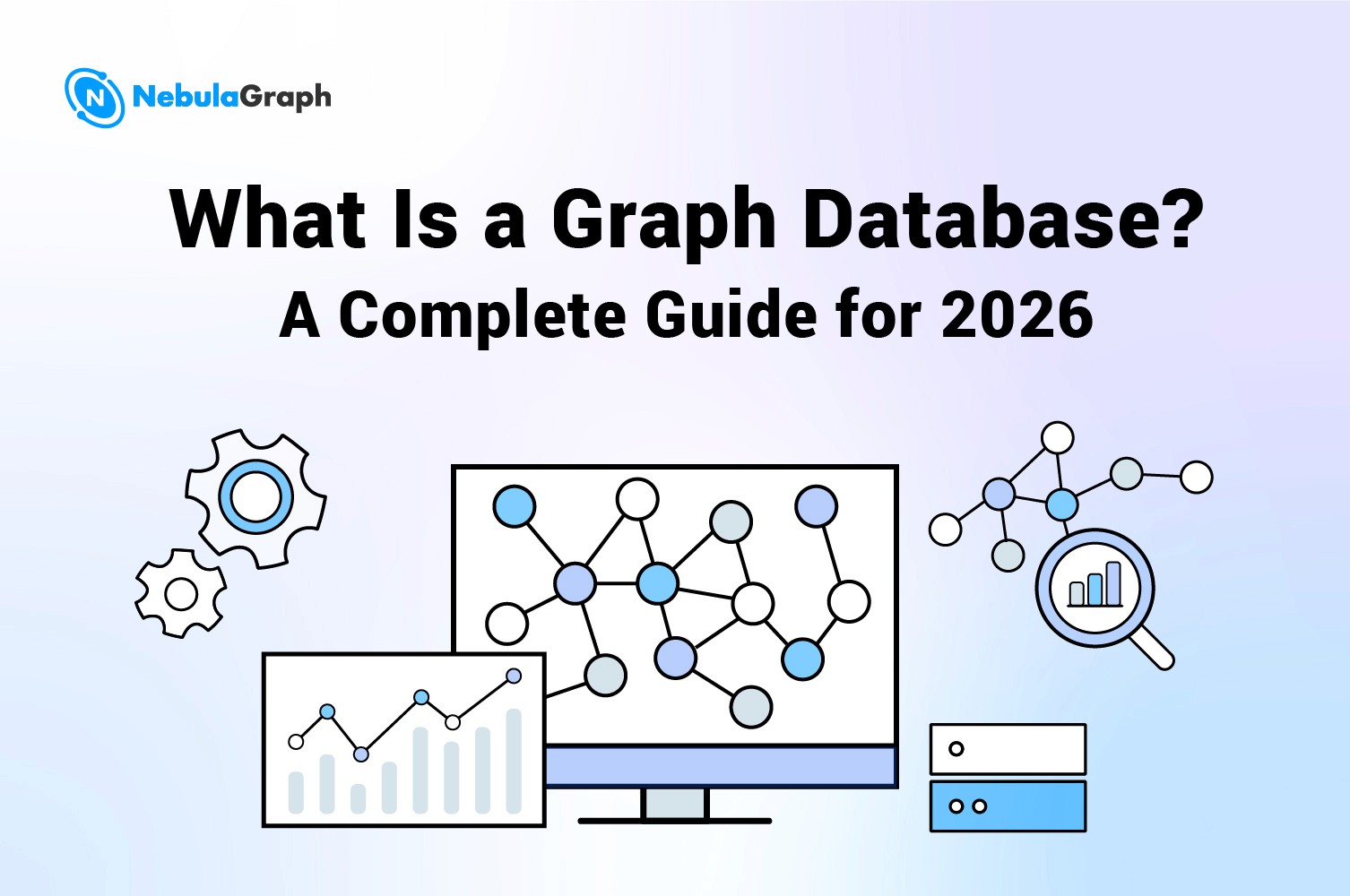
At its core, a graph is a way to model relationships. It consists of:
Nodes (or vertices): Represent entities—like people, bank accounts, web pages, or servers.
Edges: Represent connections between them—like friendships, transactions, hyperlinks, or data flows.
This structure is surprisingly powerful. Whether you’re mapping equity ownership in a corporate group, tracing disease spread, or analyzing user behavior in an app, graphs capture the “who is connected to whom” that traditional tables often miss.
Why Can’t We Just Use Regular Queries?
You could ask, “Who are Alice’s direct friends?” using a standard database query. But what if you want to know:
“Which users are indirectly connected to Alice through 3 mutual friends?”
“Is there a hidden group of accounts coordinating fraudulent transactions?”
“Which server is the true root cause of this system-wide outage?”
These questions require understanding the shape and flow of the entire network—not just isolated records. That’s where graph algorithms come in.
Think of them as specialized tools for exploring networks. They don’t just retrieve data—they analyze structure, uncover patterns, and quantify influence in ways relational databases simply can’t.
Three Real-World Problems Solved by Graph Algorithms
Finding the Best Route: Shortest Path Algorithms
When your GPS reroutes you around traffic, it’s likely using Dijkstra’s algorithm or a variant. It treats roads as edges (with weights for time or distance) and intersections as nodes, then computes the lowest-cost path from A to B—even in massive networks.
“People You May Know”: Link Prediction Algorithms
Social apps like LinkedIn or Instagram use algorithms like Jaccard similarity to recommend connections. The idea? If you and another user share many mutual friends, you’re likely to know each other too. The algorithm scores potential links based on shared neighbors—turning vague “maybe” into actionable suggestions.
Why This Web Page Ranks First: PageRank Algorithm
Ever wonder why some sites appear at the top of Google? PageRank treats the web as a graph: pages are nodes, and hyperlinks are votes of confidence. A page gains authority not just from how many links point to it, but from how important those linking pages are. It’s a recursive popularity contest—and it works.
How NebulaGraph Brings Graph Algorithms to Life
NebulaGraph is a scalable, open-source graph database that natively supports a rich library of graph algorithms—so you can run these powerful analyses directly on your live data, without exporting to external tools.
Whether you’re using the community or enterprise edition, NebulaGraph provides production-ready implementations of key algorithm categories:
Algorithm | Description | Scenario | Properties name | Properties type |
|---|---|---|---|---|
PageRank | The rank of pages | Web page ranking, key node mining | pagerank | double/string |
Louvain | Louvain | Community mining, hierarchical clustering | louvain | int/string |
KCore | K core | Community discovery, financial risk control | kcore | int/string |
LabelPropagation | Label propagation | Information spreading, advertising, and community discovery | lpa | int/string |
Hanp | Label propagation advanced | Community discovery, recommendation system | hanp | int/string |
ConnectedComponent | Weakly connected component | Community discovery, island discovery | cc | int/string |
StronglyConnectedComponent | Strongly connected component | Community discovery | scc | int/string |
ShortestPath | The shortest path | Path planning, network planning | shortestpath | string |
TriangleCount | Triangle counting | Network structure analysis | trianglecount | int/string |
GraphTriangleCount | Graph triangle counting | Network structure and tightness analysis | count | int |
BetweennessCentrality | Intermediate centrality | Key node mining, node influence computing | betweenness | double/string |
ClosenessCentrality | Closeness centrality | Key node mining, node influence computing | closeness | double/string |
DegreeStatic | Degree of statistical | Graph structure analysis | degree,inDegree,outDegree | int/string |
ClusteringCoefficient | Aggregation coefficient | Recommendation system, telecom fraud analysis | clustercoefficient | double/string |
Jaccard | Jaccard similarity | Similarity computing, recommendation system | jaccard | string |
BFS | Breadth-First Search | Sequence traversal, shortest path planning | bfs | string |
DFS | Depth-First Search | Sequence traversal, shortest path planning | dfs | string |
Node2Vec | - | Graph classification | node2vec | string |
The enterprise version goes further—supporting advanced algorithms like InfoMap (for hierarchical communities), HyperANF (for estimating graph size), and even custom algorithms written in ISO-GQL, the emerging international standard for graph queries.
Note: When writing the algorithm results into the NebulaGraph, make sure that the tag in the corresponding graph space has properties names and data types corresponding to the table above.
Real Companies, Real Impact: How They Use NebulaGraph Algorithms
Root Cause Analysis in 20 Seconds — Boss Zhipin
Boss Zhipin, a leading recruitment platform in Asia, faced slow incident diagnosis across its microservices. By modeling traces, metrics, and logs as a graph, they applied PageRank to identify “storm centers”—nodes with high failure weights based on error rates and dependencies. Result? Root causes are pinpointed in under 20 seconds, slashing MTTR (Mean Time to Resolution).
Fraud Detection at Scale — China Mobile
With hundreds of millions of users, China Mobile built a massive social graph and ran Louvain and HANP community detection algorithms. These uncovered hidden clusters—like groups of users sharing devices or locations—then scored each community for risk. Suspicious clusters (e.g., low credit + high churn) triggered automated reviews, reducing fraud losses significantly.
Risk Propagation in Insurance — ZhongAn Insurance
When processing loan applications, ZhongAn used Label Propagation to spread “risk labels” from known defaulters through the user graph. If a new applicant was tightly connected to multiple labeled high-risk users, the system flagged them for manual review—catching collusive fraud rings traditional rules would miss.
They also used Connected Components to detect unusual “family contact” clusters (e.g., 60 people listing the same number as “mom”). Such dense, atypical subgraphs became early warning signals for identity fraud.
Final Thought: Relationships Are the New Data
In a world drowning in data but starving for insight, the connections between things often matter more than the things themselves. Graph algorithms help you see those connections.
Whether you’re optimizing delivery routes, stopping financial crime, or personalizing user experiences, the power isn’t just in having data—it’s in understanding how it’s linked.
The real value starts when you apply these algorithms to your own data. Try NebulaGraph today —and turn relationships into results!