Technical Deep Dives
Building the Future of Intelligent Banking with Graph Technology
NebulaGraph
Traditional Data Infrastructure Is Holding Back Modern Banking Risk Management
Financial institutions today operate in an increasingly complex risk environment. Banks must detect sophisticated fraud networks, comply with evolving regulatory requirements, evaluate customer risk in real time, and make faster decisions across billions of connected data points.
However, many banking systems still rely on traditional relational databases and data warehouses that were designed for structured transactions. A single customer may be connected to thousands of entities through accounts, transactions, devices, merchants, locations, organizations, and digital behaviors. Identifying hidden patterns across these relationships often requires complex joins, costly data pipelines, and long processing times.
For modern banks, the challenge is understanding the connections within data and turning relationships into actionable intelligence.
This is where graph databases are becoming a critical foundation for next-generation financial risk analytics and AI applications.
The Growing Need for Graph Databases in Financial Services
Financial services data naturally forms a network:
Customers are connected to accounts, transactions, and financial products.
Accounts are connected through shared devices, addresses, and beneficiaries.
Businesses are connected through ownership structures and supply chains.
Transactions reveal behavioral patterns and potential risk signals.
Traditional relational databases store these relationships through tables and foreign keys. In a relational database environment, discovering multi-hop relationships often requires multiple table joins across massive datasets, resulting in slow query performance, complex data models, high infrastructure costs, and limited ability to support real-time decision-making.
Graph databases solve this challenge by treating relationships as first-class data. Instead of reconstructing connections through expensive joins, graph databases store entities and their relationships directly, enabling fast traversal across complex networks.
Key Banking Use Cases Powered by Graph Databases
1. Real-Time Fraud Detection and Financial Crime Prevention
Fraud rarely happens through isolated events. Modern fraud schemes involve networks of connected accounts, identities, devices, and transactions. Graph databases enable banks to analyze these connections in real time and uncover suspicious patterns that traditional systems may miss.
For example, a graph-powered fraud detection system can identify:
Multiple accounts controlled by the same device
Coordinated transaction patterns across different regions
Hidden relationships between customers and high-risk entities
Synthetic identity networks created through shared attributes
By combining graph analytics with machine learning models, banks can move from rule-based fraud detection toward intelligent risk prediction.
2. Anti-Money Laundering (AML) and Investigation Intelligence
AML investigations require understanding complex financial networks involving customers, organizations, transactions, and external entities. Traditional investigation processes often require analysts to manually connect fragmented information from multiple systems.
A knowledge graph built on a graph database can unify customer profiles, transaction histories, account relationships, corporate ownership structures, and regulatory watchlists. Investigators can then explore the complete relationship network, identify suspicious clusters, and reduce investigation time.
Graph databases transform AML from searching for individual suspicious transactions into understanding entire risk ecosystems.
3. Customer Intelligence and Personalized Financial Services
Banks increasingly need deeper customer understanding to deliver personalized products and experiences. Graph databases help financial institutions connect customer behaviors, preferences, financial activities, and life events into a unified customer intelligence graph.
With graph-powered insights, banks can:
Identify customer relationships and household networks
Recommend relevant financial products
Improve customer segmentation
Detect changing financial behaviors
When combined with AI models, graph data provides richer context for more accurate predictions and recommendations.
Graph Database + AI: Building the Foundation for Intelligent Banking
The next generation of banking AI requires more than large language models. AI systems need accurate, contextual, and trusted data to generate reliable insights. This is where graph databases and knowledge graphs become essential.
Knowledge Graphs Provide Context AI Models Need
Large language models (LLMs) are powerful, but they do not inherently understand an organization’s private data, business rules, or complex relationships. Knowledge graphs enhance AI systems by representing business entities, relationships, domain knowledge, historical interactions, and risk signals.
For banks, a knowledge graph can connect customers, accounts, transactions, regulations, and risk indicators into a structured intelligence layer. This enables AI systems to reason over trusted financial data instead of relying only on unstructured information.
GraphRAG Enables More Accurate AI for Financial Applications
Retrieval-Augmented Generation (RAG) has become a popular approach for improving enterprise AI applications. However, traditional RAG approaches often rely primarily on keyword or vector similarity search, which may fail to capture complex relationships.
GraphRAG combines graph databases with generative AI by retrieving information based on relationships and context.For financial institutions, GraphRAG can power applications such as:
AI-Powered Risk Analysis
An AI assistant can analyze a customer’s risk profile by retrieving connected information across transaction networks, related entities, historical behaviors, and regulatory information. Instead of providing isolated facts, the AI system can generate explanations based on relationship-aware insights.
Intelligent Compliance Assistance
Compliance teams can use GraphRAG-powered assistants to quickly answer questions by connecting regulations, internal policies, customers, and transaction histories.
Financial Investigation Copilots
Investigators can interact with AI systems that understand complex financial networks and automatically summarize suspicious relationships.
How to Choose the Right Graph Database for Banking Applications
Selecting a graph database for enterprise banking workloads requires more than evaluating basic graph capabilities. Financial institutions need a platform that can support massive-scale data processing, real-time decision-making, AI innovation, and long-term business growth.
1. Enterprise-Scale Performance and Scalability
Banking applications generate enormous volumes of connected data, from transaction networks and customer relationships to corporate structures and risk signals. A graph database designed for financial workloads must be able to scale as data complexity grows while maintaining consistent query performance.
Key considerations include distributed architecture, horizontal scalability, and the ability to handle billions of nodes and relationships efficiently. This ensures that risk analytics, fraud detection, and AI applications can continue operating reliably as business requirements expand.
2. Real-Time Graph Query and Analytics Capabilities
In financial services, timely insights can directly impact risk decisions and customer experiences. Whether identifying fraudulent transactions, analyzing customer relationships, or investigating complex financial networks, banks need graph databases that can uncover connections quickly.
A suitable solution should provide low-latency graph traversal, efficient graph algorithms, and real-time relationship analysis, enabling organizations to move from reactive investigation to proactive risk management.
3. AI and Knowledge Graph Readiness
As banks accelerate AI adoption, graph databases are becoming a critical foundation for building intelligent financial applications. However, AI systems require more than access to raw data; they need contextual understanding of entities, relationships, and business knowledge.
A future-ready graph database should support knowledge graph development, graph analytics, and AI-driven architectures such as GraphRAG. By connecting structured relationships with generative AI, banks can build more accurate risk analysis systems, intelligent assistants, and domain-specific AI applications.
4. Enterprise Reliability and Operational Efficiency
For large financial institutions, technology infrastructure must meet strict requirements around availability, security, and operational management. A graph database should provide enterprise-grade reliability while integrating smoothly with existing data platforms and application ecosystems.
Capabilities such as high availability, fault tolerance, security controls, and simplified cluster management help ensure that graph-powered applications can operate at production scale with confidence.
Why Banks Choose NebulaGraph for Next-Generation Risk Analytics
Modern financial institutions need more than a graph database that can store connected data. They need a complete graph intelligence foundation that can help them discover relationships, perform large-scale analytics, and power AI-driven decision-making.
NebulaGraph provides this foundation through two complementary capabilities: NebulaGraph Database for scalable graph data management and real-time relationship queries, and NebulaGraph Analytics for advanced graph computation on massive-scale connected data. They enable banks to transform complex financial data into actionable intelligence for fraud prevention, risk management, compliance, and AI innovation.
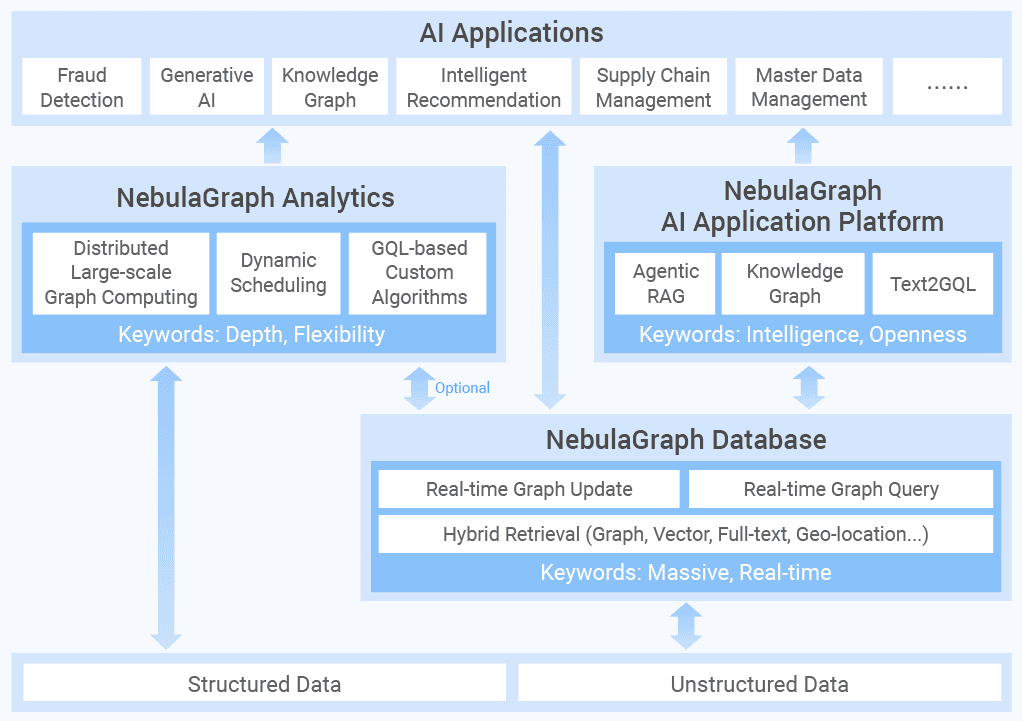
fig.: NebulaGraph Enterprise v5.3 Overall Product Architecture
NebulaGraph Database: Building a Scalable Foundation for Connected Financial Data
Financial organizations generate enormous volumes of interconnected data across customers, accounts, transactions, devices, merchants, and organizations. Managing these relationships requires a graph database that can deliver both enterprise-scale scalability and real-time performance.
NebulaGraph Database is built for large-scale graph workloads, enabling banks to model complex financial relationships naturally and analyze connections with low-latency graph traversal.
With NebulaGraph Database, financial institutions can build enterprise knowledge graphs that unify fragmented data sources and create a connected view of risk. This relationship-centric data foundation enables real-time applications such as fraud detection, customer intelligence, AML investigation, and risk assessment.
NebulaGraph Analytics: Unlocking Intelligence from Billions of Relationships
As financial institutions build increasingly large knowledge graphs, storing relationships is only the first step. The real challenge is extracting insights from billions of connections through efficient graph computation.
NebulaGraph Analytics extends graph capabilities beyond storage and querying by enabling large-scale graph computation and advanced analytics on massive relationship networks.
Unlike traditional analytics approaches that struggle with complex relationship analysis at scale, NebulaGraph Analytics allows organizations to perform computationally intensive graph workloads, including community detection, similarity analysis, path finding, and other customized graph algorithms.
For banking risk scenarios, this enables deeper analysis such as:
Identifying hidden fraud rings through community detection and relationship clustering
Discovering suspicious money flows across multi-hop transaction networks
Measuring influence and connectivity between financial entities
Generating risk features from large-scale relationship patterns
NebulaGraph Analytics also supports business-driven algorithm development, allowing financial teams to customize analytical logic based on their specific risk models and compliance requirements instead of relying only on predefined algorithms.
Powering AI-Ready Banking with NebulaGraph Fusion GraphRAG
NebulaGraph Database and NebulaGraph Analytics provide the data intelligence layer required for next-generation AI applications. Knowledge graphs built on NebulaGraph help banks provide AI systems with structured business context, connecting entities, relationships, and domain knowledge that traditional data systems often fail to capture.
When combined with Fusion GraphRAG architectures, NebulaGraph enables AI applications to retrieve information based not only on keyword similarity but also on meaningful relationships between entities. This allows financial AI assistants to generate more accurate, explainable, and context-aware insights.
By combining real-time graph queries, large-scale graph analytics, and AI capabilities, NebulaGraph helps financial institutions move from fragmented data analysis toward intelligent, relationship-driven decision-making.
Conclusion: Building the Future of Intelligent Banking with Graph Technology
The future of financial services depends on the ability to understand relationships. As banking organizations adopt AI-driven decision-making, graph databases are becoming a critical data foundation for connecting information, discovering hidden risks, and powering intelligent applications.
For financial institutions evaluating graph database solutions, the key question is no longer whether graph technology is valuable, but whether their infrastructure is ready for the scale, speed, and intelligence required by modern banking.
NebulaGraph helps enterprises unlock the value of connected data and build AI-powered financial intelligence systems that are faster, smarter, and more scalable.
Contact us and explore how NebulaGraph can help your organization build real-time risk analytics and AI-ready knowledge graphs!