NebulaGraph Enterprise v5.3: Graph-Native Intelligence for the Ontology-Driven AI Era
NebulaGraph
News
Over the past month, our ontology series has explored how ontology provides the semantic foundation for enterprise AI and how NebulaGraph provides the high-performance engine that makes ontology operational. We've seen how ontology transforms enterprise AI across fraud detection, recommendation systems, and supply chain intelligence. The common thread across all three domains is clear: ontology provides the semantic layer that makes data operationally meaningful, and graph databases like NebulaGraph provide the high-performance engine that makes ontology operational at scale.
As AI models grow more sophisticated, the data they consume must become richer, more flexible, and more accessible.This is precisely what NebulaGraph Enterprise v5.3 delivers. With enhancements spanning data modeling, AI integration, and enterprise-grade performance, v5.3 closes the loop between ontology design and AI execution, making it easier than ever to build, deploy, and scale ontology-driven AI applications.
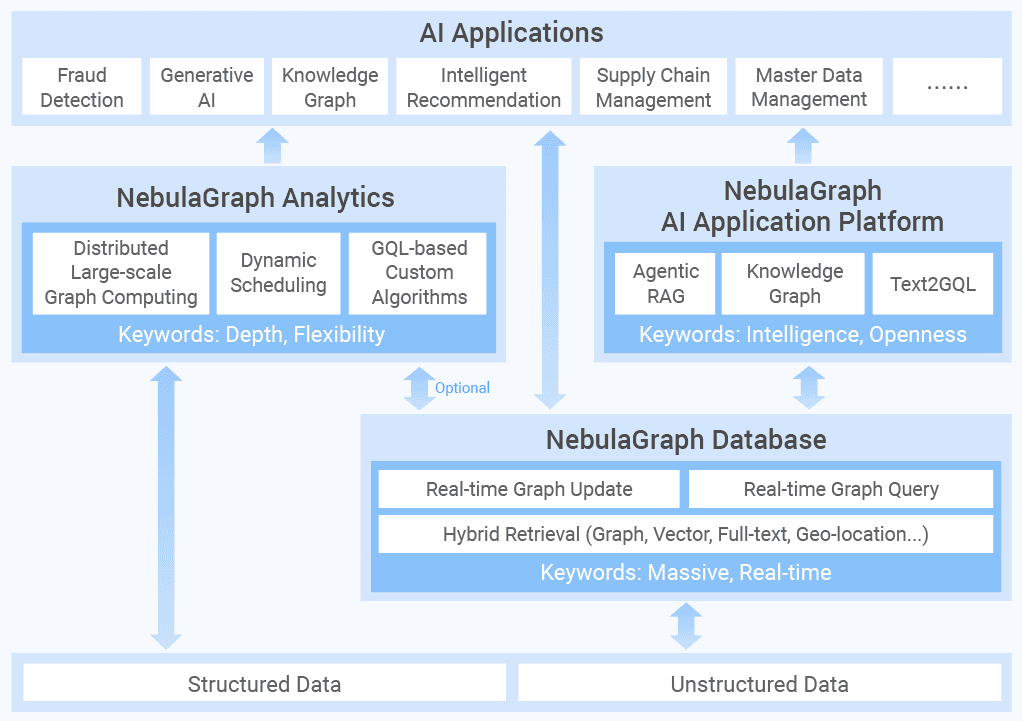
fig: NebulaGraph Enterprise v5.3 Overall Product Architecture
Richer Data Modeling for Ontology-Driven AI
An ontology provides the semantic foundation of an AI-ready knowledge graph by defining entity types, properties, and relationships. However, real-world AI applications also rely on dynamic, multi-valued, and context-specific information that extends beyond a fixed ontology.
NebulaGraph Enterprise v5.3 supports richer data modeling through data types such as SET and MAP, enabling graphs to capture this additional context while preserving a clean and consistent ontology.
The SET data type is well suited for representing multi-valued attributes such as user interests, product tags, knowledge classifications, or risk labels. Rather than modeling every AI-generated feature as a separate vertex or relationship, these attributes can be stored directly with the corresponding entities, enriching the ontology with semantic context that recommendation, retrieval, and reasoning models can leverage.
The MAP data type complements this by supporting flexible key-value attributes for information that evolves over time, such as prompt metadata, agent state, configuration parameters, or application-specific context. This allows AI systems to associate dynamic information with ontology-defined entities without requiring frequent schema changes as workloads evolve.
By combining a stable ontology with flexible data modeling, organizations can maintain semantic consistency while accommodating the evolving data requirements of LLMs, AI agents, and other intelligent applications.
Making Graph Intelligence Accessible to AI
Storing data is only half the battle. The real value comes from making that data actionable, enabling AI systems to discover patterns, generate insights, and answer complex questions. NebulaGraph Enterprise v5.3 delivers a comprehensive set of capabilities that turn NebulaGraph into a true AI-ready data platform.
Built-In Graph Algorithms: From Retrieval to Discovery
NebulaGraph Enterprise v5.3 now supports a significantly expanded library of built-in graph algorithms across six major categories: Centrality, Path Finding, Community Detection, Similarity, Node Embedding, and Topological Link Prediction.
What this means for AI: These algorithms enable AI systems to do more than retrieve known facts, and they can discover hidden relationships. An AI agent can automatically detect fraud rings through community detection, identify emerging customer segments through similarity analysis, and predict supply chain risks through link prediction. The ontology provides the semantic framework, and the algorithms provide the intelligence.
Aggregation + SubGraph: Building Blocks for GraphRAG
NebulaGraph Enterprise v5.3 introduces comprehensive horizontal aggregation functions and the SubGraph function. They work together to power GraphRAG applications.
Aggregation functions enable rapid construction of multi-dimensional statistical metrics and features directly within graph queries. Instead of exporting data to external analytics platforms, AI models can now compute counts, sums, averages, and distributions directly from the graph, reducing data movement and ensuring features are always fresh.
The SubGraph function enables fast extraction of localized knowledge networks related to a target entity. When an LLM needs to answer a question about a specific entity, SubGraph extracts exactly that: the entity, its immediate neighbors, and the relationships that matter for the current context. This dramatically improves GraphRAG retrieval quality by reducing noise and focusing the LLM's attention on the most relevant information.
These capabilities help AI models build multi-dimensional statistical features while extracting precise, relevant subgraphs, delivering higher-quality retrieval and more explainable results.
Enterprise-Grade Performance, Reliability, and Cost Control
AI applications demand infrastructure that is fast, reliable, and cost-efficient. NebulaGraph Enterprise v5.3 delivers on all three fronts with a series of performance and operational enhancements.
Performance Optimization
NebulaGraph Enterprise v5.3 introduces comprehensive performance optimizations, including dynamic query plan selection, query interpreter improvements, late materialization, and vertex-centric indexing.
The results: Graph computation performance improves by an average of 2.2x; graph query performance improves by an average of 1.87x.
Faster graph traversals means faster response times for real-time AI applications, faster feature extraction for model training, and faster retrieval for GraphRAG. When an AI agent needs to traverse a complex network for multi-hop relationship queries, v5.3 delivers results in a fraction of the time, enabling truly interactive AI experiences.
High Availability + Multi-Tenancy: Production-Ready AI Infrastructure
NebulaGraph Enterprise v5.3 supports a full range of high-availability deployment architectures: same-city active-standby disaster recovery, same-city active-active, cross-region disaster recovery, and three-region five-data-center configurations. Cluster synchronization operates in near-real time.
Complementing this is comprehensive multi-tenancy and quota management, allowing organizations to control resource usage across different AI agents, teams, and applications. In a large enterprise, multiple AI agents may be querying the graph simultaneously. Multi-tenancy ensures that every agent gets the resources it needs when it needs them.
A high-availability graph data foundation that keeps AI services available 24/7, with resource controls that prevent any single workload from impacting others.
Dynamic Replica Adjustment + Dry Run: Cost-Effective Development to Production
NebulaGraph Enterprise v5.3 supports online replica count adjustment without service interruption, making it easier to adapt deployment configurations as AI projects mature. During early development, testing, or proof-of-concept (PoC) phases, a single replica is often sufficient because availability requirements are relatively low. As applications transition to production and require higher reliability and fault tolerance, replica counts can be increased online without disrupting services. This flexibility allows organizations to evolve from cost-efficient development environments to highly available production deployments with minimal operational overhead.
Dry Run mode allows users to validate query syntax, execution plans, and potential data impact ranges without actually executing the query. When an AI agent generates a graph query through GQL Skills, there's always a risk of malformed syntax or inefficient execution plans. Dry Run mode enables developers and AI agents to catch these issues before they hit production, reducing debugging time, preventing accidental resource exhaustion, and accelerating the development lifecycle.
Conclusion
Throughout our ontology series, we've seen how ontology provides the semantic foundation for enterprise AI and how NebulaGraph provides the high-performance engine that makes ontology operational. From fraud detection to recommendation systems to supply chain intelligence, the combination of explicit semantics and graph-native speed has proven to be the winning formula.
NebulaGraph Enterprise v5.3 takes this formula to the next level:
Richer data modeling: SET and MAP types bring AI features into the graph, completing the ontology picture with support for multi-valued and dynamic attributes.
Smarter AI access: Built-in algorithms, aggregation, and SubGraph make graph intelligence more accessible, enhancing the completeness and interpretability of AI analysis results.
Faster, more reliable infrastructure: 2.2x computation, 1.87x query performance, enterprise-grade high availability, multi-tenancy, dynamic replica adjustment, and Dry Run mode deliver the speed, stability, and cost control that production AI demands.
Whether you're building fraud detection systems, recommendation engines, supply chain intelligence, or the next generation of AI agents, NebulaGraph Enterprise v5.3 gives you the semantic power and operational speed you need!
Ready to Upgrade?
NebulaGraph Enterprise v5.3 is now available! Contact us today to learn more about the new features, or schedule a migration consultation!