How Graph Databases Power Intelligent Recruitment Recommendations at Global Scale
NebulaGraph
Case Studies
Recruitment has become one of the most data-intensive recommendation scenarios. Every day, online hiring platforms process millions of searches, job applications, resume updates, and recruiter interactions. Behind every successful match lies a complex network of relationships connecting candidates, skills, employers, industries, career paths, and user behaviors.
One of the world's largest online recruitment platforms faced exactly this challenge. As its business expanded globally, traditional recommendation technologies were no longer sufficient to understand the increasingly complex relationships within its talent ecosystem. The platform needed a recommendation engine that could go beyond keyword matching, discover hidden connections across massive datasets, and deliver accurate, explainable recommendations in real time.
By adopting a graph-native architecture powered by NebulaGraph, the platform transformed its recruitment recommendation system into an intelligent knowledge-driven engine capable of modeling billions of relationships at scale.
Why Traditional Recruitment Recommendations Reach Their Limits
Most recruitment platforms started with keyword-based search and recommendation engines. While straightforward to implement, these systems become increasingly ineffective as data volume and relationship complexity grow.
A simple keyword overlap rarely represents true professional relevance. For example, a candidate specializing in frontend development may be recommended for UI/UX designer roles simply because both resumes contain terms such as "user interface" and "design." While the keywords overlap, the required expertise, responsibilities, and career paths are fundamentally different. Traditional keyword matching struggles to recognize this context, often leading to irrelevant recommendations.
More importantly, traditional recommendation models struggle to capture the relationships that define modern recruitment:
Similar technical skills with different names
Career progression across companies and industries
Transferable expertise between related job roles
Behavioral patterns hidden in searches, applications, and recruiter interactions
Connections between companies, technologies, certifications, and domains
As recommendation models become increasingly dependent on deep learning, another challenge emerges: explainability. Black-box models may generate accurate predictions, but they rarely explain why a candidate is recommended for a particular position, making it difficult for recruiters and candidates to build trust in the results.
Recruitment is fundamentally a connected-data problem. Solving it requires understanding relationships, not just matching keywords.
Graph-Based Recruitment Recommendation: Modeling Relationships Instead of Keywords
Graph databases offer a different way to build recommendation systems.
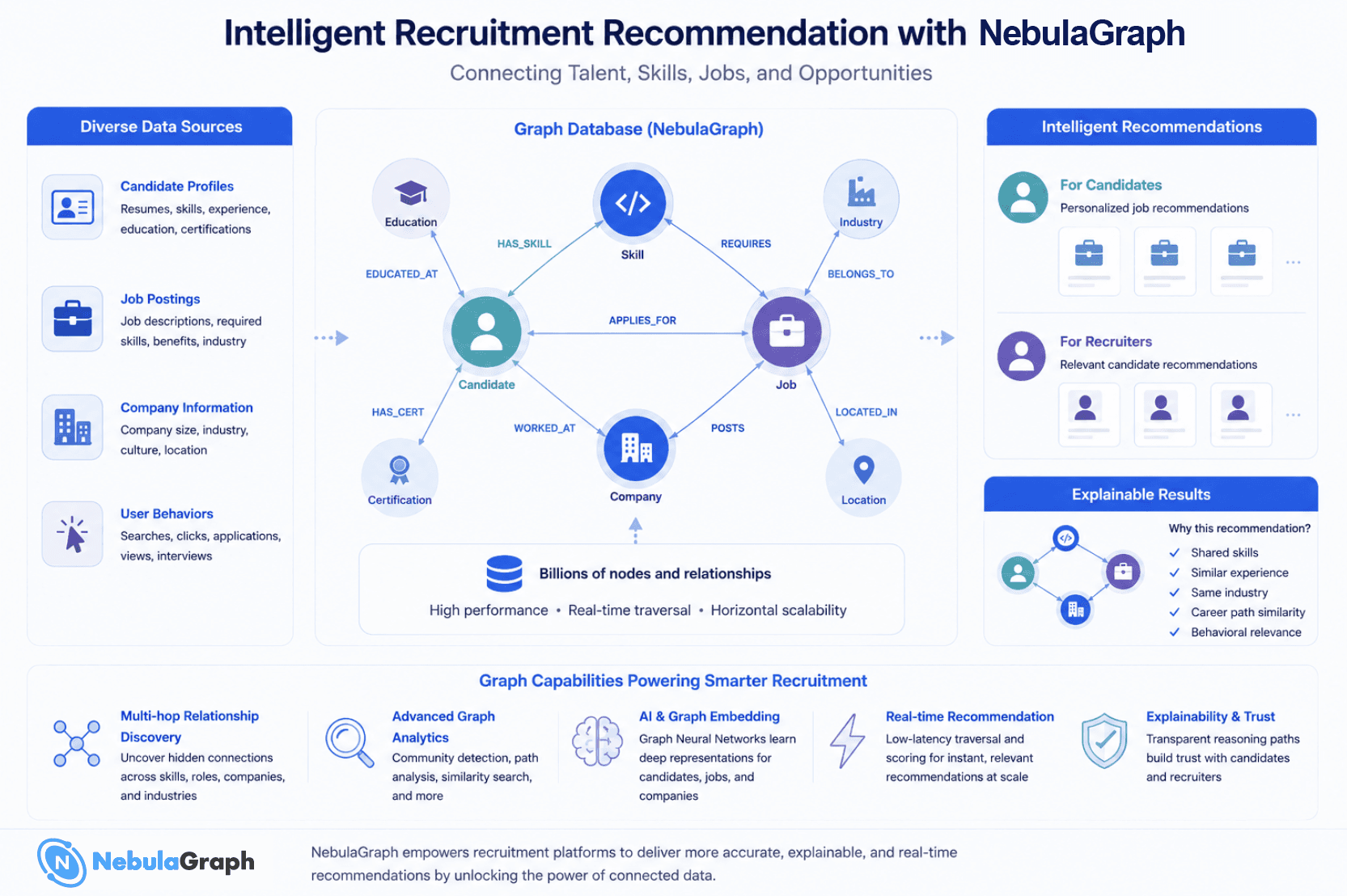
Instead of treating resumes, jobs, companies, and skills as isolated records, graph databases model them as interconnected entities linked through meaningful relationships. Every interaction—from a candidate applying for a role to a recruiter viewing a profile—becomes part of an evolving knowledge graph.
This global leading recruitment platform built its recommendation engine around two complementary graph models. Recommendation scenarios that previously required complex offline processing can now be supported with more real-time relationship analysis.
A Taxonomy Graph for Structured Recruitment Knowledge
The first layer organizes recruitment knowledge into a structured graph.
Skills, occupations, certifications, industries, benefits, education, and other concepts are connected through hierarchical relationships. Synonyms and alternative expressions are mapped to standardized entities, allowing the recommendation engine to understand that "Adobe Photoshop," "Photoshop," and "PS" represent the same capability.
This graph also enables intelligent search features such as:
Skill normalization
Semantic search
Autocomplete suggestions
Related skill discovery
Dynamic filtering
Instead of relying on literal text matching, the platform understands the semantic relationships behind recruitment data.
A Relationship Graph That Continuously Learns
While the taxonomy graph provides structured domain knowledge, the second layer captures real-world interactions.
Candidate profiles, job postings, employers, searches, clicks, applications, interviews, and hiring outcomes are connected into a continuously evolving relationship graph.
Unlike static recommendation models, this graph grows smarter with every interaction. Multi-hop relationships reveal valuable patterns, such as:
Candidates with similar career trajectories
Frequently co-occurring skills
Common promotion paths
Industry transitions
Hidden similarities between employers
These relationship signals significantly improve recommendation quality while enabling recommendations that evolve alongside changing user behaviors.
How NebulaGraph Powers Intelligent Recruitment Recommendations
Managing billions of interconnected entities requires infrastructure specifically designed for graph workloads. NebulaGraph serves as the graph database foundation supporting the platform's intelligent recommendation engine.
High-Performance Relationship Traversal
Recruitment recommendations often require traversing multiple degrees of relationships within milliseconds.
For a global recruitment platform processing billions of relationships, even small inefficiencies in graph exploration can directly impact user experience. A single recommendation request may require analyzing connections across candidates, skills, companies, industries, education backgrounds, and historical interactions.
With NebulaGraph, these relationships are modeled natively as a graph, enabling low-latency multi-hop traversal without the complex join operations required by traditional relational architectures. This allows the platform to deliver personalized recommendations while maintaining performance as data volume continues to grow.
Large-Scale Knowledge Graph Management
The recruitment platform maintains an extensive knowledge graph containing entities such as candidates, employers, occupations, certifications, technologies, industries, and behavioral events.
The graph represents the interconnected talent ecosystem. Managing this scale requires more than simply storing large volumes of data, the system must continuously update relationships, support complex queries, and provide insights with predictable performance.
NebulaGraph's distributed architecture enables horizontal scalability, allowing the platform to expand its graph infrastructure as data volume, user activity, and recommendation complexity continue to increase.
AI-Powered Similarity Discovery
Beyond explicit relationships, the platform leverages graph embeddings and graph neural networks (GNNs) to learn vector representations of candidates, jobs, and organizations.
These embeddings capture structural context across the graph, allowing the recommendation engine to identify highly relevant opportunities even when candidates have never explicitly listed specific skills or experiences.
Instead of asking whether two resumes contain identical keywords, the system asks whether two career journeys are structurally similar.
Explainable Recommendations
One of the greatest advantages of graph databases is transparency.
Because every recommendation is backed by traversable relationships, recruiters can understand why a candidate appears in the recommendation list. Shared skills, similar career paths, common employers, and related industries all become visible through graph exploration.
This level of explainability increases user confidence while providing valuable insights for continuously improving recommendation strategies.
From Data Scale to Business Possibilities
The biggest advantage of graph technology is not only improving existing recommendation workflows, but enabling entirely new ways of understanding talent relationships. It is about enabling new capabilities that were previously difficult or impossible to achieve with traditional database architectures.
With graph-powered recommendations, the platform can analyze relationships across billions of data points to uncover talent connections that are invisible in traditional systems. For example, it can identify candidates with transferable skills from adjacent industries, discover common career paths among successful employees, and recommend opportunities based on relationship patterns rather than explicit keyword matches.
Similarly, recruiters can explore talent pools by following relationship paths across industries, technologies, and career movements, uncovering qualified candidates who may not appear in conventional keyword searches.
These capabilities allow recruitment teams to move beyond reactive search and build proactive talent intelligence, finding the right candidates before they even begin searching for new opportunities.
Business Impact
By replacing keyword-centric recommendation with graph-native intelligence, the platform achieved a recommendation engine capable of understanding context instead of isolated attributes.
More importantly, graph technology changed what the platform could do with its data. NebulaGraph enabled the platform to:
Improve recommendation relevance through relationship-aware matching
Discover hidden connections between candidates, skills, and opportunities
Support real-time recommendations across massive datasets
Deliver explainable recommendation results that increase recruiter trust
Build a continuously evolving knowledge graph that improves as user interactions grow
Rather than viewing recruitment as a search problem, the platform now treats it as a connected intelligence problem.
Conclusion
Modern recruitment is about understanding relationships.
Candidates, employers, skills, career paths, industries, and behavioral signals form an interconnected ecosystem that cannot be fully represented by traditional relational models or isolated machine learning features alone. Graph databases provide a natural foundation for modeling this complexity, enabling recommendation systems that are more accurate, more explainable, and continuously adaptive.
This global recruitment platform demonstrates how graph technology can transform large-scale talent matching by combining knowledge graphs, behavioral data, and AI-driven relationship analysis into a unified recommendation architecture.
As organizations increasingly build AI-powered applications, graph databases are becoming a critical component for recommendation engines, GraphRAG, fraud detection, customer intelligence, and knowledge-driven AI systems. NebulaGraph provides the scalability, performance, and flexibility needed to power these applications in production.
Ready to build intelligent recommendation systems with graph technology?
Whether you're modernizing a recruitment platform or developing the next generation of AI applications, NebulaGraph helps you uncover hidden relationships, deliver real-time insights, and turn connected data into smarter decisions.
Contact us and explore how NebulaGraph can accelerate your graph-powered innovation!
Read More About Intelligent Recommendations: